Introduction
Consumers and users looking to gain access to resources or proceed with other transactions now pretty much expect some form of Multi-Factor Authentication (MFA) or two-factor authentication (2FA), as necessary protocols. Typical examples include the One-Time Password (OTP), the receipt and acknowledgement of time-sensitive codes, or real-time alerts.
This authentication moment matters more than most businesses realise. A login code that arrives too late or not at all can leave users locked out of critical accounts or platforms. A delayed or missed fraud alert could expose corporate clients and partners to business risks that might negatively impact their operations and profit margins.
Failure to reach all stakeholders with the alerts and authentication data they need reflects badly on the enterprise which sends out these communications. This can lead to customer churn, damage to their business reputation, and lost revenue. In the commercial sector, a two-second delay in OTP delivery can make or break the customer journey, inspiring frustrated buyers to look elsewhere for gratification. In extreme cases, authentication delay or failure may lead to regulatory compliance issues, or even litigation.
Bearing these risk factors in mind, it’s essential that enterprises use a reliable and readily accessible avenue for authentication and alerts.
Why SMS Still Dominates Enterprise Authentication
First developed in the 1990s, the SMS or Short Message Service protocol has been one of the world’s most frequently used forms of text communication since 2010. In 2026, users globally send around 25 billion text messages every day. Adding Multimedia Messaging Service (MMS), and Rich Communication Services (RCS) into the mix, users worldwide send about 275,000 texts every second. This equates to roughly three texts per person, for the entire world population.
While MMS and RCS may require special hardware, SMS is a device-agnostic protocol available to smart and feature phone users alike. It requires no internet connection, making it accessible to anyone within range of an active cellular network. Across the globe, over half of the population send and receive texts every day. Of these users, around 80% will check their text notifications within five minutes of receiving them, or less.
This kind of activity sets up SMS as an ideal vehicle for making time-sensitive and important business communications. Moreover, established wisdom holds that 98% of message recipients will open an SMS message, as opposed to around 20%-28% in the case of email. So it’s little surprise that over 70% of all businesses today say they use some form of text messaging to contact their customers and subscribers. As a result, people worldwide receive SMS messages for business purposes roughly 3 trillion times per year.
For businesses, SMS transmission doesn’t rely on operating systems, specific user hardware, or specialist applications. Instead, it operates through standard mobile carrier networks. This allows messages to arrive directly in the recipient’s inbox, independent of Wi-Fi or mobile data. Its accessibility and the recipients’ fast response make SMS ideal for time-sensitive operational interactions. Enterprises benefit from a cost-effective deployment model that allows them to pay for SMS authentication services on a usage or per message-basis. SMS OTP 2026 is currently acceptable to major regulatory compliance frameworks such as GDPR and HIPAA.
In 2026, Juniper Research’s A2P messaging studies predict sustained growth in messaging traffic, driven by application-to-person or A2P SMS authentication, service updates, and enterprise communication.
Use Cases for Enterprise SMS Authentication
Implementing business SMS authentication involves a simple workflow.
1. A customer or user enters their credentials on a website, platform, or app.
2. Once the credentials check out, the enterprise sends an authentication code, which typically has a validity from zero to sixty seconds.
3. When the SMS authentication code reaches the recipient, they can enter the number into the platform.
4. The platform validates the code, and grants the customer access to proceed with their transactions.

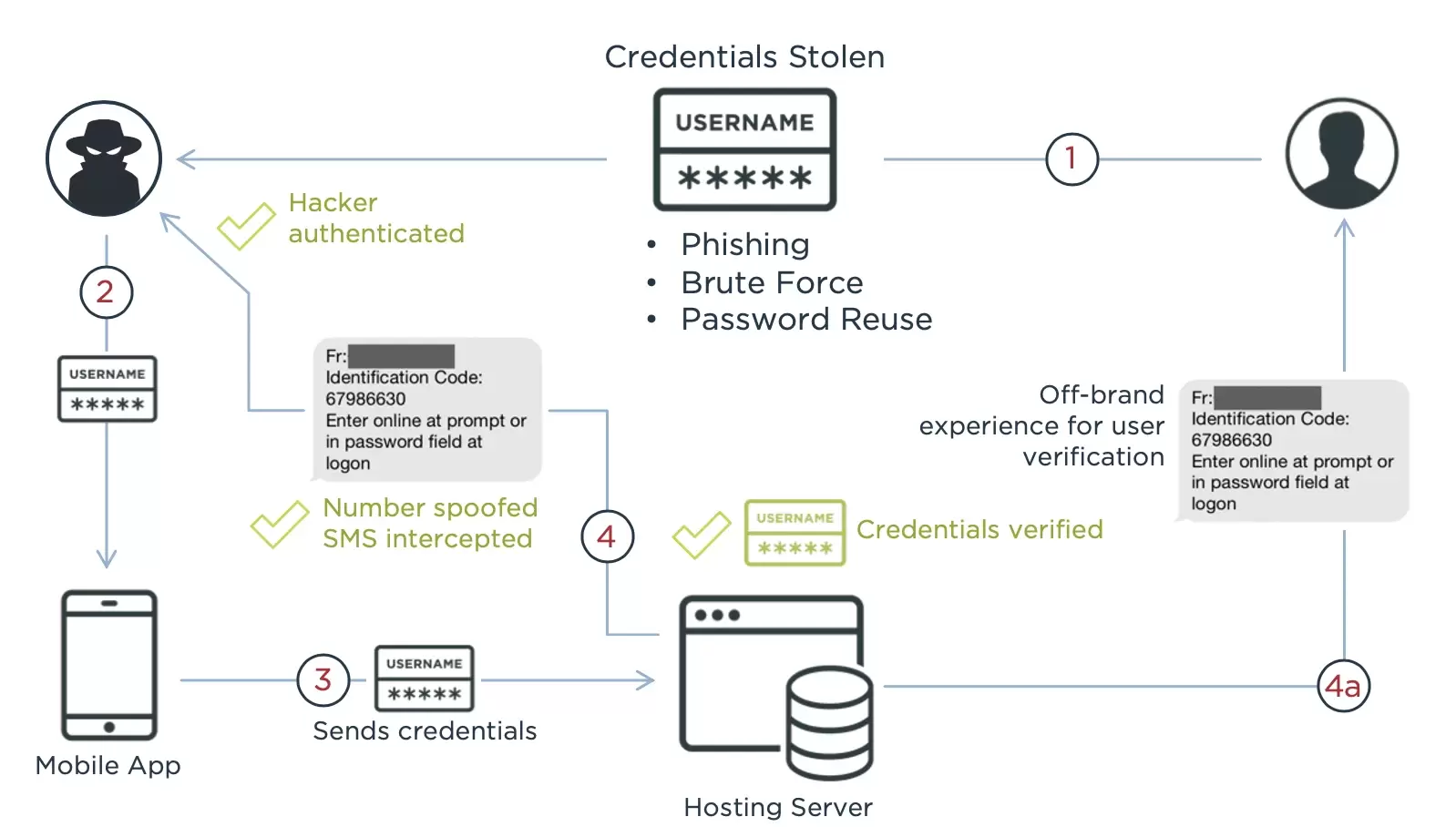
[Image Source: Pingidentity]
The universal reach of SMS enables enterprises to communicate with customers and stakeholders across mature and emerging markets, in both regulated and unregulated industries.
Besides SMS authentication using OTPs and the transmission of account access and fraud alerts, businesses use messaging for appointment and event reminders, service or payment notifications, and delivery or logistics updates. Two-way SMS communication enables enterprises to field user support requests, clarify the status of customer orders, confirm or reschedule appointments, and collect feedback from consumers.
Drilling down to specifics, banks and fintech platforms typically use SMS authentication to validate login procedures or to complete transfers of assets – especially with sensitive or high-value transactions.
Businesses in the eCommerce sector use SMS codes to verify new customers or transactions. With the proper opt-in and opt-out protocols in place, SMS also facilitates marketing efforts, allowing eCommerce players to send special offers and promotions, as well as tracking orders and deliveries.
Hospitals, clinics, and healthcare portals use SMS authentication to marshal access to clinical resources and medical records.
Within any business, enterprise managers can use SMS 2FA to control access to corporate records or email, HR portals, and remote tools.
SMS vs App Authentication and Other Alternatives
While globally accessible and popular with users, SMS authentication does come with certain risks that enterprises need to be aware of.
SIM swapping is one. Here, bad actors can fool mobile carriers into swapping a recipient’s phone number to a new SIM card which is under their control. This effectively redirects any verification codes or messages to the attacker’s account. Malicious apps or insecure wireless protocols can also enable fraudsters to intercept SMS messages on compromised devices.
Malicious actors may also use phishing or social engineering tactics to pose as trusted parties (such as enterprise customer support), and trick consumers into revealing their SMS authentication codes.
In light of such vulnerabilities, some regulations (including the updated NIST guidelines) discourage using SMS for highly sensitive data or applications. Today, enterprises are advised to take an orchestrated approach, deploying SMS in conjunction with other methods, such as app authentication or other messaging protocols.
While RCS is growing in popularity, it remains fragmented by market. WhatsApp has uneven global penetration, currently only 32% in the US. So these platforms lack the reach of SMS.
App-based tools such as Google Authenticator avoid wireless networks, generating codes on a user’s personal device. The user must take responsibility for downloading and managing the app.
Enterprise push notifications don’t rely on inputting codes, allowing recipients to simply tap to confirm. However, they do require an internet connection, and dedicated smartphone apps.
Hardware tokens like RSA SecurID avoid the risk of remote hacks or SIM swapping. However, businesses may find them difficult and costly to distribute and maintain. Users also have a tendency to forget, damage or lose them.
Biometric authentication methods such as fingerprint or facial recognition are another option. This ensures robust security, in that biometric data is difficult for third parties to fake. However, implementation requires specialist hardware, which users may be unable to find or afford.
Requirements for Good Business SMS Authentication
As we noted earlier in this article, an SMS authentication code or alert that is late or doesn’t reach its destination at all can have dire consequences for the enterprise. So it’s important for businesses to adopt best practices, to ensure that their all their SMS messaging achieves the desired effect.
First, make sure that your sender ID complies with all relevant regulations in your area of operations. For example, enterprise SMS messaging in the US requires ten-digit long code or 10DLC registration, and the registration of your brand and campaigns. Provide opt-in and opt-out mechanisms for all marketing.
Ensure that your infrastructure generates unique SMS codes that expire quickly, to reduce the window for bad actors to attack. Monitor transmission routes for suspicious activity, such as repeated failed attempts, authentication requests from unusual locations, or rapid-fire requests for new codes.
Your SMS platform should provide global routing, to ensure delivery across countries and operators. It should offer redundant routing to maintain business continuity if primary routes fail, and Unicode support to enable the correct rendering of local languages.
SMS OTP 2026 and Beyond
In 2026 and through the next decade, SMS authentication is expected to play a major role in multi-factor enterprise security, especially in regions with limited mobile data or low smartphone usage.
Silent Authentication or Phone Number Auth is emerging as the next evolution, backed by Meta, GSMA and leading telecommunications companies. But SMS OTP remains essential today and will continue to be for the foreseeable future. So the quality of your SMS provider remains a partnership decision that’s business-critical.
IDT Global employs an extensive network of over 100 direct carrier connections and a robust compliance-focused A2P messaging platform, to ensure reliable, high-deliverability routes globally.
Speak to IDT global about enterprise-grade SMS authentication, today.